Expert advice on selecting the right paper for your book's look, feel, and durability.
Selecting the right paper is one of the most important decisions in book printing. It affects not only how your book looks, but also how it feels, reads, and even how much it costs to produce.
This guide will help you understand paper weights, finishes, and common options so you can confidently choose what works best for your project.
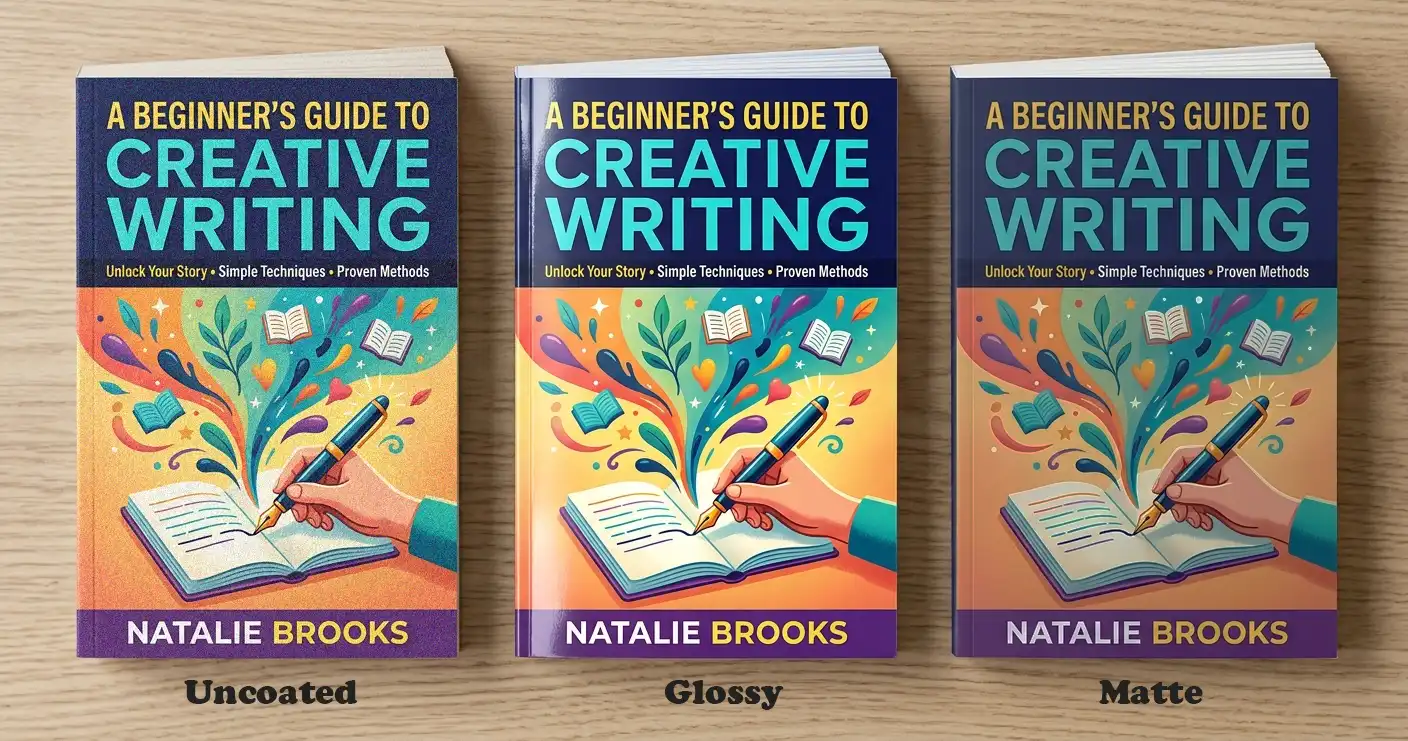
The finish of the paper affects how the ink sits on the page and how the reader interacts with the book.
| Paper Type | Pros | Cons | Best For |
|---|---|---|---|
| Uncoated | Classic feel, easy to write on, no glare under lights. | Ink "soaks in," causing colors to appear slightly muted. | Novels, Poetry, Memoirs, Workbooks. |
| Matte Coated | Smooth, professional look with high color contrast and no reflection. | Can show "fingermarking" more easily than glossy. | Photography books, Yearbooks, Tech Manuals. |
| Glossy Coated | Vibrant, "pop" colors and high-shine finish. | Highly reflective; can be difficult to read text under bright light. | Art books, Cookbooks, High-end Catalogs. |
In the printing industry, weight is measured in three main ways. Understanding these ensures your book feels exactly how you imagined.
Grams per Square Meter. This is the international standard and the most consistent unit globally. Whether it's text or cover, the higher the GSM, the heavier the paper.
👉 Best for comparison: GSM is the most consistent and easiest way to compare paper across different types.
Pounds per 500 sheets. This is common in the USA. Note: 80 lb Text is much thinner than 80 lb Cover because they are measured from different base sizes. The base size for text stock is 25" x 38", and the base size for cover stock is 20" x 26".
👉 Key takeaway: Always confirm whether it's text stock or cover stock when you see lb.
Caliper. This measures the actual thickness of a single sheet (1 pt = 1/1000th of an inch). This is primarily used for Cover Stock and Belly Bands.
👉 Important: Two papers with the same GSM can have different thicknesses depending on how they are manufactured.
Text Stock is flexible and designed for the interior pages of your book. Cover Stock (or Cardstock) is rigid and heavy, designed to protect the "guts" of the book.
| Stock Type | GSM (Metric) | lb (U.S.) | Typical Use Case |
|---|---|---|---|
| Standard Text | 80 - 90 gsm | 50 - 60 lb Text | Standard novels and black & white interiors. |
| Premium Text | 105 - 120 gsm | 70 - 80 lb Text | Color books, memoirs, and higher-quality fiction. |
| Heavy Text | 150 gsm | 100 lb Text | Children's books and professional catalogs. |
| Standard Cover | 210 - 250 gsm | 80 - 90 lb Cover | Standard paperback (TPB) covers. |
| Premium Cover | 300 - 350 gsm | 110 - 130 lb Cover | Heavy-duty covers, 12pt to 14pt thickness. |
When choosing your paper, keep these two industry terms in mind to avoid common printing pitfalls:
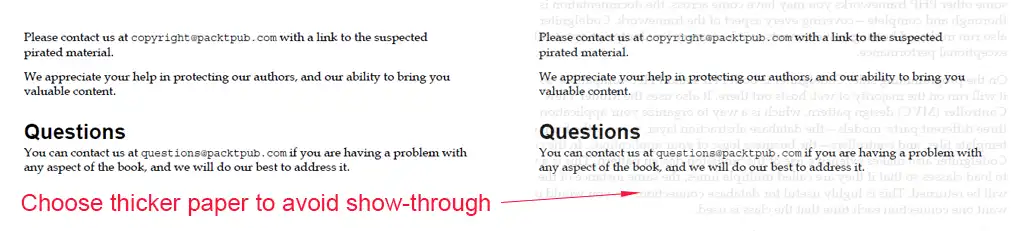
Opacity refers to how much light passes through the sheet. If your paper is too thin, the text from the back side will "show through" to the front, which can be distracting for the reader. We recommend at least 100gsm for books with heavy ink coverage.
The thickness of your paper determines the width of your book spine. A thicker 120gsm paper will have a much lower PPI (fewer pages per inch) than an 80gsm paper, making the physical book appear thicker on the shelf.
Find the approximate PPI from the following table based on the types of paper and their weights.
| Paper Weight (lb.) | Uncoated | Glossy | Matte |
|---|---|---|---|
| 55 | 488 | 828 | 664 |
| 70 | 394 | 610 | 500 |
| 85 | 330 | 487 | 405 |
| 105 | 271 | 382 | 322 |
| 135 | 214 | 289 | 246 |